WARNING!!
All content on this website is copyrighted. Do not use any content of this website without our written permission, to include photos.


Monday, June 8, 2015

The newest thing for your gaming console

So you remember how the losers on Jeopardy would get the Jeopardy Home Edition game as a consolation prize?  (Why do I suspect that actual Jeopardy contestants aren't the board game's target audience?)

Well, allow me to introduce you to the Agriculture Home Edition game.
I... I have nothing further to add.

Sunday, June 7, 2015

Yet another sign you're no longer in the suburbs

An overheard etiquette lesson:
"Dude!  You hold the door open for a lady when she's carrying a gun."


Okay, to be fair, that particular comment was at the entrance of a sporting goods store as Caryl was leaving, rifle in hand.  But it also reflects the reality that small arms are a given when you live in the countryside.  To be sure, there are a couple of our neighbors1 who also migrated out of the city who aren't so thrilled about personal firearms, but they decidedly are the exception.

Besides seasonal hunting, in Nebraska it's entirely legal and acceptable to kill a predator that's threatening your livestock or poultry, and it's legal to hunt an animal that has killed your animals. This is essential not only for the monetary value of the livestock (and the downrange monetary value of its products) but also because of the home economic value -- if your meal plans, or wallet,  depend on eggs (or home-butchered chicken, pork, and beef) then you need to make sure it goes into your mouth and not some coyote's.  As Caryl puts it, "I'm not setting out a buffet."
And we have had our share of predatory visits.  Caryl already mentioned (and will detail later) that one of our first four pullets was taken in November, most likely by a fox.  About a week after that, a predator (probably a dog) tried very aggressively to get into the City Biddy coop during the night.  And we've had at least one fox make a recon run around the Oo-de-Lally Egghouse this spring.  So, we put electric hotwire around the old coop until the new coop was ready for poultry.  And we noted how the dog was able to get some purchase to remove part of the coop's siding, to inform some of the design decisions on the new coop.  And, yes, we have firearms.


Now if only we were allowed to hunt herbivores that threaten our crops and/or have eaten leaves off of trees.  (My poor new, baby trees now all have to live within large wire cages or behind multiple rows of electric fencing.  Tree jail, I call it. ~Caryl)
Yes, I'm looking at you, Bambi.


1Loosely defined as "Someone whose house I can see from my house."

Saturday, June 6, 2015

The Crazy World of Chickens

I have always wanted chickens.  This desire remained buried for decades, until we stopped moving about.  It was a revelation that surprised no one, except my father, who somehow missed the fact that I was a dirt digging, outdoor loving, fishing, hunting, shooting kind of girl.  I'm still trying to figure that one out.  But I digress.

Back to the chickens.

As SOON as we found out we were moving to an area I could actually not only HAVE chickens, but have as MANY chickens as I wanted, I wasted no time!  We were still two months from moving, but I was going to start my first coop AND order my first pullets. (I'm just not a fan of the fluffy butt stage, but I'll get more to that later.)  My thought was, if I was able to keep a few birds alive, through a Nebraska winter, I could manage more later.

I set out to find plans for my perfect starter coop.  After reading and researching, I knew what I DID'T want, which is one of those assemble it your self coops from the local pet/seed/hardware store.  Nope.  They were ALL too small, too poorly built, had no ventilation, and NO predator security.  Sometime the wrong tools will set you up for failure before you even begin. So that route was out.

So I continued my search.  I came across an internet site with plans for a cute little coop that touted that it held 4 birds, was easy to build, relatively inexpensive, and easily accessible for clean up.  It WAS adorable, so I ordered it and began building it immediately!  The City Biddy seemed to be JUST what I was looking for.  It took three weeks to build, and many, many trips to the hardware store, which luckily, was just 10 minutes down the road. Building in the driveway certainly aroused the attention of my golf course living, home association, retiree neighborhood.  Many of whom were shocked and amazed that a woman knew how to use power tools.  ::Sigh::

The plans had many critical errors in them, and when the designers were told of these errors, they simply stopped answering my emails.  So IF you choose this plan, be aware of the errors in measurements.  It is a cute coop.  It is ridiculously heavy.  It is too small for 4 birds,  and I would change many things about it. And for it's size cost and arm and a leg, less than 14 square feet and $500.   Would I build it again? NO WAY.  But it was a great learning experience towards the giant coop that would follow 6 months later.


So fast forward to the big move.  Did I mention this was heavy?  We couldn't get it into the UHaul truck as the ramp was 4 inches too narrow.  (It must have been designed by the man who designed my truck, which is 4 inches too narrow to fit a full sheet of plywood.)  We hastily cut plywood to lay over the ramp to enlarge it, and with GREAT effort, in it went. It looked SO large at the old house, until we unloaded it here.

Birds were arriving in two weeks.  Where to set it up became an almost daily game.  The tiny wheels made it difficult to move around a country lawn, but with our trusty plywood tracks, we had it traveling all over the property.  We also went through several incarnations of runs before we settled on taking apart two dog kennels and combining them with zip ties, and covering them with fiberglass panels. This certainly worked, but had major flaws.  Like I said, the coop was too small.  Sadly, one of the girls was taken by either a loose dog or a fox one afternoon, so the coop was down to three, which was still small, but much better.  The run was only 44 inches high, which led to access issues.
  However, by the time I realized how much of a pain the little coop was.  I had much bigger plans in mind!

By early December I was sure I could do this and had picked up on the changes I needed to make. Again I started listing what I wanted and didn't want in a permanent coop and run. I also needed to get the ball rolling before my rolling green hills and soft earth turned into this,
or EVERYTHING would have to wait for April, which brings the wet and the heat.


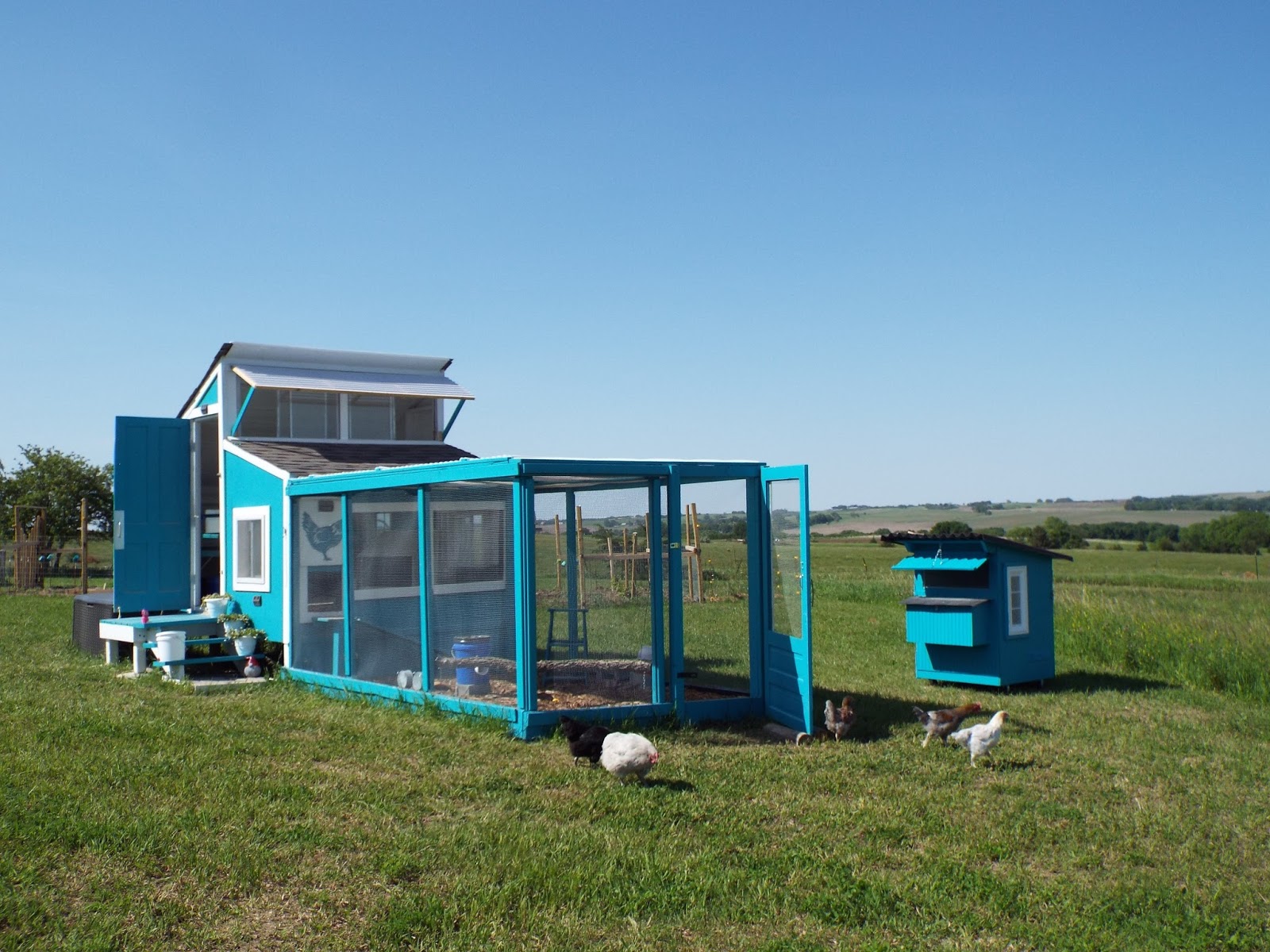
I knew I wanted a coop large enough to walk into.  No more stooping, or kneeling, crawling or bending to try to build, chase a bird, scoop poop,  or change out food/water.  I couldn't stand that anymore.  It had to be secure, protect from the elements (and critters), have a poop board, large nesting area and be easily attached to a secure run.  PLUS, it had to look nice :)

The search was on.  After many hours, nay days, I found exactly what I was looking for.  Tried and true plan, sound theory, I took the plunge and ordered the book Fresh-Air Poultry Houses.

It's a reprint of a 100 year old book.  It contains several poultry houses and the principles of how each one works, based on fluid dynamics. It does not, per se, have "plans".  This book was written before big box lumber yards and now commonly used stick lumber.  It does have great drawings and measurements. Using basic tools and skills, you can build one of these.  I will say that they all rely on specific ratios to keep the birds warm and cool, so while you can change the sizes of the coops (to a point), you cannot change the ratios.

I decided on the Woods Style coop.

As you can see, I drew.  I scrubbed, figured, crunched numbers, made lists, and generally made a mess of my book.  It was then time to venture to the county planning office.  Yes, my county requires a permit for any structure of a certain size.  Anything over 100 square feet, however, not only required a permit, but inspections and blueprints.  But for a chicken coop?  Well, they honestly didn't know.  It didn't have plumbing or electricity, but it was permanent. Hmmm... to be on the safe side, we all agreed to a permit.  But at 96 square feet, detailed blueprints definitely weren't needed.  That was in mid-December.

Now for the home owner's association architectural board.  "Wait! I thought you were out in the country?!" you chime.  Yes I am, BUT I also live in a group of houses that have a loose set of covenants.  I am fine with them.  The committee is there to protect everyone's view. Since many were away on vacation, it took until January for them to get back to me, but they were fine with the style, and the color was up to me! I went with Valspar's True Teal, an electric teal blue. (The online swatch doesn't come close.)

My goal was to be done by May1st. I put in my order for my new pullets, and started looking at paint swatches!  Keep in mind I was still moving into a new house and all that entails.  This was FAR from my ONLY project, but it was the biggest.  I made my lists and headed to my local hardware and lumber store, which was 1 hour and 12 minutes away.  I was there so often in the upcoming months that I was treated like visiting royalty every time.  Employees went out of their way to help me and get weekly updates on the little teal coop.

Winter smacked us in the head with a vengeance in November.  We fell far below normal and winds and temperatures hit 0' months before schedule.  I was worried what I would be up against in January, February, and March.  But I had a deadline looming. So I was going to have to give it a whirl.

Next time.... the build begins.


Tuesday, June 2, 2015

Another sign you're no longer in the suburbs

Rush hour has a different look.
Tractor with anhydrous ammonia applicator
Rush hour, not quite.
Okay, the photo overplays the point, but my morning and afternoon commutes really are different than what I've had anywhere else.  Before, I only had relaxing commutes at those places where we lived close enough to my work that I could safely walk or ride my bike.  Now, as a specific point of comparison -- when we lived in Lincoln it took me 20-25 minutes to drive 8 1/2 miles to/from work.  At our current home, it takes me 25-30 minutes to drive 23 miles to/from the same workplace.

I timed it this morning.  The first 8.7 miles I covered in 9 1/2 minutes -- this morning I encountered one farm implement and a half-dozen cars on that stretch.  Between farms and the nearby Branched Oak Lake State Recreation Area, this isn't far from typical for any given time of the day.  At the end of that stretch, I finally encountered other people driving into (or from) the city.  Traffic was unusually heavy this morning; I had to wait (gasp!) 30 seconds at the stop sign before I could make my turn.  At 19 minutes I hit real traffic shortly before the I-80 interchange.  Another 8 minutes for the last five miles, and I'm at work.

Having 90% of my daily commute be stress-free driving is remarkably--relaxing.  So is not listening to traffic before I leave in the morning and for hours after I get home.

The only downside is gasoline.  Make no mistake, I'm getting much better fuel economy, but miles per gallon isn't the right measure; gallons per commute is.  By that standard, I'm going through twice as much gasoline now than I did before we moved to Dunrovin Station.  But I think an increased fuel bill isn't a bad price for sanity.

Monday, June 1, 2015

Spring is a BUSY time in the Country

Mercy, land sakes alive I'm busy!

You can plan and plan and plan your long, cold, dark winter days away, but when Spring FINALLY does come, it seems to come all at once in this part of the country.  Which means everything seems to need tending to all at the same time.

Of course a great deal of that this year is because it is the FIRST year on the acreage.

The garden didn't just need tilled, planned, and planted like most Spring gardens, but it needed plotted out. It needed the 147 year old sod broken, tilled three times by my most gracious neighbor, posts put in, a fence installed, electric fence put up, gate built, boxes built, trellis put up, hay ordered. Then, and ONLY then, was I able to fulfill my winter plan of actually PLANTING the seeds. But not in the GROUND.  Oh no. 

There is a danger of frost here until at least May 15th.  Usually Mother's Day is a good bet.  But honestly, you're better off waiting it out, and then you still better be ready to cover the tender seedlings.  Tomatoes?  I don't even bother putting them in the ground until June 1st.  Of course, I started the seeds in the kitchen in the middle of April.  They just don't DO anything until not only the soil temperatures hit 74', but until the night air is warm.  So why risk it?  So today, I put in 28 various, long, leggy tomato plants.  They are planted laying down and very deep.  They are fertilized and deeply watered.  Tomorrow I will finish weeding the garden and lay the final thick layer of prairie grass mulch.

The broccoli, cabbage, scallions, shallots, grapes, blackberries, potatoes (both Viking  and Gold),and onions are going to town.  The corn is finally popping up after having to be replanted, as are the peas and green beans.  The umbrella sorghum, broom sorghum, cantaloupe, and giant dill are all just breaking the surface. The sweet potatoes look happy enough.  The banana peppers are struggling, and there is still no sign of the garlic or horseradish.

Then there is the orchard.  Normally early, early Spring is the time for pruning.  Mid-Spring is the time for spraying.  Not this this year.  We needed to plot the orchard.  Figure out what trees we wanted, and had to make sure each one was suitable for here AND had a pollinator partner.  They needed tracked down and purchased and hauled home.  I now know I can get 10 5-gallon 10-foot trees in my Chevy Traverse.  People look at me funny when I load that truck, but are shocked at what I can get into it! We ended up with 18 trees: 3 plum, 3 pears, and 13 various apple trees.

We found out, but are not surprised, that we need to put up deer fencing.  So that's another project.

We have a large hay meadow and clover field, which is now almost 3 feet high, (I LOVE clover) and that demanded that I put in a mason bee box and water station.

We were blessed with a mild enough winter that I was able to bundle up like a TaunTaun jockey and work on the coop. By February, Winter finally socked us with permafrost, which meant ANY digging, just had to wait until the thaw.

Wait, back up.  COOP?!  Yes, while I have been insanely busy with everything, everyday, my largest project was building a very large chicken coop.  I started with a tiny coop meant for small, urban/suburban flocks, the City Biddy Coop.  It was advertised as housing 4, but barely fit three.  (It's a good thing that our Penny went to Ha-wee-wee. But that is a story for another day.)  Well I wanted more than three, so I went bigger: MUCH bigger.  I went from 12 sq feet to 100, including the run- 200!  I also went from 3 chickens to 17!  I researched and asked what seemed like a zillion questions and settled on a coop.  I chose a 100 year old plan and just winged it!  I have many step by step photos and it will be a post all its own. So all of my patient backyardchickens.com friends, hang in there!

All right.  My break is over.  It's time to make dinner and get back out to the orchard.

Thanks for stopping in :)

Sunday, May 31, 2015

A sign you're no longer in the suburbs

Just as there are certain sentences that are impossible to come out of your mouth until you've had children ("Get your foot off the banana in the school bus"), there are some things that you don't see or hear until you've left Suburbia.  Such as:


The postmaster tells you, "Huh.  This box of chickens sounds different than the others."

Chicken shipping box
Yes, chickens can arrive by mail

Caryl here- Just to clarify for all you non-chicken types.  MOST people, when they order chickens through the US Mail (yes, critters ship through the US Mail) they order day old, cute, fluffy, tiny chicks.  Chicks that chirp and peep like a sunny Easter morning.  However, I am not a huge fan of the baby stage.  Sure, if one of my hens decides to go broody and raise her own batch of fluffy butts, she can go for it. But I prefer the pre-teen age range of pullets.

They're cutely awkward, have personalities, are more cold tolerant, and passed the major cootie catching phase.  The bit that makes them raise their eyebrows at the post office is the larger than normal boxes for the birds, and the noise.  Oh, the noise.  10 week old Pullets no longer make the cute peeping, chirping noise. They also do not yet make the barnyard 'boo, bok, bok, bok" that you remember on school field trips to the local farm or petting zoo.  Like all teens, they are in the midst of a change.  So what does a teenage chicken sound like?  I liken it to a battle scene from a space movie, laser blasters shooting down long hallways as heroes and villains duck in and around doorways.  "Pew,pew,pew!" You have to admit, THAT IS an odd noise coming from a box!

 ( I get my flock from ChickenScratchPoultry)

Saturday, May 30, 2015

The Emergance of Dunrovin' Station

Like all stories, this story must have a beginning.  However this tale starts much further back than most blogs.  Oh sure, I've had other blogs in the past.  There was one about WWII Combat Engineers (which I still have the notes for anyone doing research), one about my art and watercolors, and one about quilting.  None of them are live in the blogosphere any longer.

I have decided to have a catch-all blog.  It will encompass all adventures that are Dunrovin Station in West Oak, Nebraska.  What is Dunrovin Station you might ask?  Good question.


Let's open the antique pocket watch and wind it backwards over 147 years to 1868. I love this quote from the Lincoln, Nebraska journal (1880s) "The greatest debt this country of magnificent distances, marvelous natural wonders, and home of freedom, can ever contract will not be so much with the millionaire monopolist, or its gazetted elite as will with the noble, self-denying men and women, who have launched out into they trackless wilds beyond the frontier.  Men may speak of Columbus, and sneer at his discovery, call him a restless, shiftless rover without resource and executive ability, and cynically speak of the "accidental stumble" against the West India Islands by that world-renowned navigator, but such tongues should be silent before the grand army of pioneers who went out from their  Eastern homes, and pushed beyond the confines of civilization in order to develop and open up to the world the boundless resources of this glorious country...(sic)"


The story of the station begins with a Civil War veteran named Volney A. Markel, born in Canada and raised in Findlay, Ohio.  After serving with the 21st Ohio Volunteers in the Civil War, he traveled to Lincoln, Nebraska- a mere village at the time only having 28 houses, and one hotel, which doubled as the center of the village and the newspaper building.   Allowed to purchase property, not only by the National Homesteading Act, but by his good standing discharge from the Union Army after the war, he surveyed lands north of Lincoln, Nebraska and chose 120 acres of prime high land, with a stream, access to a nearby small village and less than two miles to a church and school.  In 1871, he married Phoebe Ann Sutton of Iowa.


He filed his Homestead paperwork, plopped down his $14 and set out to make the mandatory improvements on the property.  He built a sod home, and then later a cabin.  They broke ground, through native grasses that grew over 6 feet tall, and that had never seen a plow.  Oxen strained against the tack.  Blades and backs broke under the endless toil.  There were few trees, save for a few cottonwoods along the stream, which cut deeply through the property.  The soft wet wood was good for neither fuel or building until well seasoned.  Crops were sparse the first year, and were hit and miss in the heavy rocky clay.  Then there was the weather.


Nebraska is notorious for its weather.  Settlers from the East came west along similar latitudes expecting similar weather as their old homes.  They couldn't have been more wrong.  Being on the edge of the expansive, flat prairielands means endless, relentless winds from Canada have nothing to slow them down.  Without trees as windbreaks, the incessant winds were know to drive settlers insane.  Even on a calm day, the winds through the high prairie grasses call out, barely above a whisper, like the voices of the ghosts of the prairie.

The summers on the prairie are sweltering.  Moisture and heat from the Gulf of Mexico surge northward and settle in the middle of the country.  Transpiration from crops and grasses increase the humidity. Temperatures can easily go over 100' and dew points in the lower 70s are common.  Imagine working in a field all day and having to lock yourself into a 10x10 soddy or cabin, where the only window is made of greased paper or leather, and cooking is done by fire, and the door must be closed at night due to wild animals and yes, still disagreements with local native tribes.  The days before daily baths, before shampoos and deodorants, and the age of layered clothing.  It makes you wish for Fall doesn't it?

Fall is my favorite season.  Warm, sunny days and cool evenings and the promise of harvest.  It is also locust season.   Billions upon billions of the monsters hatch out, eating everything in sight.  There are stories recorded of the great locust plague of 1874 where families raced home after Sunday services fearing the approaching storm clouds on the horizon.  Beating them home by mere minutes, the locusts ate everything; the clothes off the line, the line, the livestock tack (save the buckles), lace used as window screening before glass, and of course, the harvest.  So the plagues of Fall have you wishing for the first freeze of winter.

For any of you reading this that grew up watching Little House on the Prairie, there was an episode where Miss Beetle sent the children home for Christmas break early as the first flakes of snow began to fall.  The children were then caught in a blizzard, which so quickly set upon them, that they froze to death before making it home.  This episode is actually based on a real event.  It is called the Schoolhouse or Children's blizzard, January 12th, 1888.  It started as an unusually warm mid winter day, so warm in fact that some children wore nothing but their school dresses and no shoes to school that morning.  By the afternoon in South Dakota and Nebraska, the winds picked up and the temperature dropped to below zero.  Winds howled over 70 mph.  Snow blew with such a ferocity, that the visibility was below three feet.  That coupled with a landscape that had few landmarks to start with, was a recipe for disaster.  Children froze to death where they fell trying to get home.  Livestock died in the field and the out buildings.  Buildings collapsed in the wind and under the weight of the snow.  Snow drifted over 30 feet in places.  It makes you wish for Spring.


Anyone in the United States knows this is part of tornado alley.    Days in the Spring bounce back and forth between soul lifting warmth one day, and bone breaking cold the next: pouring down rain one minute, and freezing rain and snow the next.  Then there are the storms of spring.  Severe weather regularly cut large swaths across the grasslands, hail as large of grapefruit and hens eggs are the norm.

So, are you ready to move here yet?  Well Volney and Phoebe did just fine.  In fact they raised a  large family of 8 children here and ended up with a fine timber stick home with glass windows, several out building and 120 acres of crops and livestock.  He eventually sold the land and moved closer to Lincoln, where he planted a fine orchard of apple trees, and then later into Lincoln itself, when he became the first person to hold the office of Assessor.  So this property, the one we call Dunrovin Station, has changed hands a few times over the almost century and a half  it has been in play, but it is always good to know where you come from, so you can see where you are going.

So where IS this going?

Eleven months ago, my dear, sweet, patient husband, Doc, and I were bit with the "settle down" bug.  After years of moving every two to three years for over twenty years, we decided enough was enough.  We decided it was silly to continue to pay rent and fill the pockets of someone else, when we could be living in a home we love, in a place we love, all while putting money towards our own place.  Well, it all happened so quickly.  We found THE house on a Thursday, and secured a loan from the bank.  We toured the home on a Friday, and were in contract by that Sunday night.  We plopped down quite a bit more than the original $14.  When it's right, you just know.  We're done roving.....dunrovin' get it?!

We've been in the house since October 1st.  "Well why on Earth have you taken so LONG to start the blog?", you ask.  Well I have been insanely busy, details of which I will entertain in later posts.  We moved this time all on our own, no moving companies, no friends, and me with a broken toe and bone in my foot.  It only took me two weeks to totally unpack and decorated, but it has been a long 8 months of the non-stop projects and improvements that come with a new property.  I'd like to think that Volney and Phoebe still walk the fields, hand in hand and smile and what we've done with the place.


This blog will be full of all the craziness; the chickens (The Oodalally Egg House), the garden, the orchard, homeschooling (K-12 International Academy), ham radio (N0RZT, KK4GGZ, and WX4KST), country living, weather (Madis station 3452, cocorahs NE-LA-22), work, projects, cooking/baking/canning, and links to all things fun and amusing.  We'll both be posting as the mood or project strikes.  We hope you'll stop by the blog and see what we're up to.

 
Welcome to the Adventure (and Misadventures)!