I love apples. They don't necessarily love me, but most raw fruit doesn't. That doesn't keep me from breaking down every Fall and driving to the local
U-Pick it farm. Picking apples has been fabulous everywhere we've lived, except Florida and North Dakota. The blueberries in Florida were wild, and you purchased a permit from the local park system and made sure you carried a bear bell, so you startled the bears away, before they startled you. (At least that was the theory.)
In Alabama, we were up to our eyeballs in peaches.
Not only am I allergic to eating peaches, but I am also allergic to their fuzzy little hides. Sigh. In North Dakota, the winter's are hard on apples, but great for fruits and veggies, unless you've planted your orchard in a protected coulee. Everywhere else, it's been apples, apples, apples.
I grew up in apple country. In grade school, we used to take day trips to the local historical park, pick apples all morning, start a giant cast iron kettle of apple butter, and learn to carve apple head dolls, while sipping tart cider, and singing apple songs. Back when going to the orchard was less expensive than going to the grocery, my family would make trips to the orchard to pick varieties as they came available, some of my best memories EVER! You wore your working clothes, loaded up on highly toxic bug spray that made DEET look like sugar water, tossed a bandana on your head so that ticks had a really GOOD place to hide and dig in, a thermos full of water and a peanut butter sandwich, lugged bushel baskets down the rows and placed them under your trees and started climbing.


Not only did you pick apples, but you ate as you went, and no one cared. The kids giggled. Mom and great grandma told stories, and chatted, and at the end of a sweaty day, you loaded your bushel baskets into the back of the station wagon, paid the man and drove home, your torn clothes, muddy knees, and sunburned everything - a badge of honor for an honest workday of harvest. We'd store the apples in a dark corner of the cellar. Our guts so full of apples we'd swear you'd never look at another, let alone EAT another apple every again, usually as we were munching on yet another apple on the way up the steps to the shower.
As adults, we lived along the Johnny Appleseed Trail, twice. Sadly, the orchard experience is no longer the same. Varieties are no longer of the hearty, flavorful heirloom varieties; Cortland, jonathan, granny smith, russets, winesap, the nonesuch, empire, or the orange pippin. Many don't even have names because there is only the one old tree in grandma's yard that no one knows WHAT it is. Now orchards are trending towards the magical genetic designer world of fancy apples; pink lady, Ambrosia, Alexander, The Grapple, Honeycrisp, Zestars, Freedom, Lodar, Pinova. and Cameo. There is nothing wrong with the newer varieties, heck, I'm first in line when Zestar is ready to pick. They are bred to be more disease resistant, drought and moisture tolerant, take handling and storage better, and just be a better apple for today's market. My problem is that the orchard experience is gone. For one the price has gone through the roof. Many times it is far more expensive to go pick the fruit that it is to buy the beaten up old storage fruit that arrives at the grocery. When listening to visitors at the orchards I hear them reason, " well I'll pay more because it's fresh" or "part of the price is the experience of it all". (Sigh and a sad giggle.) The last time I was
there, it was an honest-to-goodness nut house. (My sister shares the same experience, but from an orchard over 1200 miles away.) They have become a place for urban dwellers to bring children for an hour and pick apples. Read that as: tear branches, toss fruit on the ground when they see a bug, have a complete meltdown when they step in mud or a piece of rotting fruit, throw fruit at each other, or otherwise act like escaped zoo animals. For the most part, the adults are no better. Sure, there are a few of us who show up to get a season's worth of fruit to put up, but precious few.
Last cherry season, not the cleanest of the orchard fruits, there was a woman there with her children and her husband who looked like they popped out of a J-Crew catalog. Mom was in a white pair of slacks and was wearing heels...to a muddy orchard. We had to hold the hay truck for them, while the husband was sent back to the SUV to get something for everyone to sit on as "hay is SO filthy." You could hear the mom screaming at the kids across the whole orchard as they misbehaved and (shocking) got dirty. The dad was having fits because there was no cell phone service "in the middle of this forsaken place." Imagine what they looked like at the end of an hour picking cherries- juice dripping out of the bags they carried, down their legs, into their shoes. I had to suppress giggles by popping fruit in my mouth on the ride back to the car. I can only imagine them getting that hot mess into that pristine truck. It still makes me giggle.
The little pay booth is long gone. You know the type. The rickety old cedar board shack that was little more than a two hole outhouse, minus the seating. It was more or less for shade for the old man, the one who helped Noah load the ark, who worked there. It usually had a little counter full of small bags of apples for those who just wanted to buy some as they drove by. If you were really lucky, there might be a couple of pies there for sale made by Mrs Old Noah's Helper. The cash box was a simple metal affair with a little metal handle, or was a plain cigar box. In a few places we lived, there was just a little bench with an honor box: no attendant, no lock, just a rock to keep the whole thing from blowing away. The little old man and his wife are long, long gone as well.
It's all been replaced with modern buildings that are
markets in and of themselves. They sell everything from jams and jellies, to pies, cakes, cookies, cider, soda, hamburgers, nachos, packaged meat, jerky, and fudge. Precious little of it made from scratch or at the orchard or from its bounty. Blaring music from local bands screams from loud speakers on decks and porches, drowning out the crickets, cicadas, birdsong, and breezes blowing through the branches. No longer does a large kettle simmer with the golden sweet aroma of apples and cinnamon, as it is drowned out by the propane jet cooking batches of kettle corn to supply the agri-tourists on their trips back to town, but only after they've spent the afternoon "tasting" wine at the wine counter. The orchards even have massive displays of pre-picked fruit, of all varieties, just in case you've driven two hours and still don't want to get dust on your shoes.
I'm not usually one to wax poetic about "the good ole' days", but dag nab it, this is one of those things that's been ruined. You many as well go the grocery store! Even the mom and pop orchards are leaning towards the tourism thing as apparently "that's what the public wants." My favorite tiny local place
here now sports a slushy machine next to the cash register. I guess the way it was, is the way it WAS, and will never be again. It's sad that kids will think that this is the way a fruit farm is. Yes, I still go to the local fruit farms. My trees are still babies, and if I want to put up cherries, apples, apple pie filling, juice, cider, blueberries, raspberries, (DROOL) apple butter, and apple sauce, etc. I'm just going to have to KEEP going for a few more years. But I do try to go before everyone else gets up and going, and certainly not on a weekend, or during an orchard promotion party. I'm certainly not knocking any of my u-pick orchards, but gracious, you just have to prepare yourself for a shopping and sociology adventure when you go!
So, back to MY orchard.
For the first time, I not only had the space, but the TIME to start an apple tree and, pardon the pun, stay around long enough to see the fruit of my labor. We've left a forest of trees behind us. Every single place I've lived, I've planted trees. Like the pioneers before, I like trees. Besides our children, it is pretty much the only living thing that we can do that will outlive us, and give enjoyment to future generations, standing tall and silently bearing witness to history. You've already read my entry about the adventures of older shade trees. Well, now it's apples. Juicy, delicious, pectin dripping orbs of late summer delight.
Most people don't know there is a trick to apple trees. They need other apple trees, pollinator buddies I call them. Think of them as field trip buddy. You stick with your buddy, share lunch with your buddy, and hopefully you both make it back on the bus and make it back to school. If you want your apple tree to produce the apple it was bred to produce, you need to make sure that somewhere nearby, there is a compatible pollinator. This is usually a tree of a parental ancestor to that tree, but can even be a crab apple tree. (This is also true of other fruiting trees.) Sometimes the nursery stock will tell you right on the tag which other varieties you need to have, other times, you are on your own. I find
http://www.orangepippintrees.com to be a ridiculously helpful site. It is mobile friendly, so it is right there in your pocket while you are shopping.
I made sure I selected varieties that were not only on my checklist, but were suitable to this area. I also had to be able to get ahold of these varieties. After the great "Arbor Day Foundation" experience, I was back to square one. I drove to many local tree nurseries and selected my varieties; yellow delicious, early harvest, red delicious, state fair, zestar (yay!), Haralson, MacIntosh, and Wolf River. I had the trees. I had their pollinator buddies. I had the space, or so I thought.
My plan HAD been to plant them in the flat land of the lower meadow. In summertime, they would have the full benefit of the full sun, and the slow runoff from summer rains to feed them. In the wintertime, they would be out of the howling, freezing winds, being protected by the valley and the hedgerow of large old growth trees and shrubs on the cattle fence. But one morning, before planting, I spotted a problem with that location, or rather, a whole HERD of problem. It seems that a small herd of whitetail deer also like the shelter of the hedgerow, and use it for their nightly napping. The game camera confirmed this in spades. Even mowing down the high prairie grass hiding holes didn't deter them. So it was on to plan B.
I opted to move the whole party to behind and uphill from the barn. I could reach it with the irrigation system if I needed to, admire it from the house, and it would be - hopefully- close enough to people to deter the giant, four legged eating machines. That having been decided, I sat down to figure out what tree needed which pollinator buddy. That ended up looking like this...
I had the variety, number of trees, and the bloom time noted. The arrow points to the variety needed for successful pollination. MacIntosh is just about my least favorite tree, but since everyone seemed to like being its buddy, I bought one.
I now needed to figure out WHERE in the orchard to plant them. I wanted to make sure everyone was within handshaking distance of their buddy. That ended up being a game of cards that looked like this...
Next was the really fun part. I needed Doc to help me grid out this mess. The trees needed to be 20 feet apart, the rows 20 feet apart, and we, absolutely had to do it on the windiest, coldest day this spring. OK, that last bit was just a bonus. Because there isn't quite anything as fun as trying to manage a 100 foot tape measure on a windy day, wearing gloves, and trying to mark SEVERAL straight lines, dig holes, and rows. We set aside an hour to do it, it took three. Two engineers, one tape measure, two ideas on how to do things, the cold, and a shovel.....uh huh. Needless to say, all the lines were marked, the holes dug, and Doc isn't IN one of them. (We actually DO work really well together, as long as we aren't hungry, or tired, or forget to communicate. LOL)

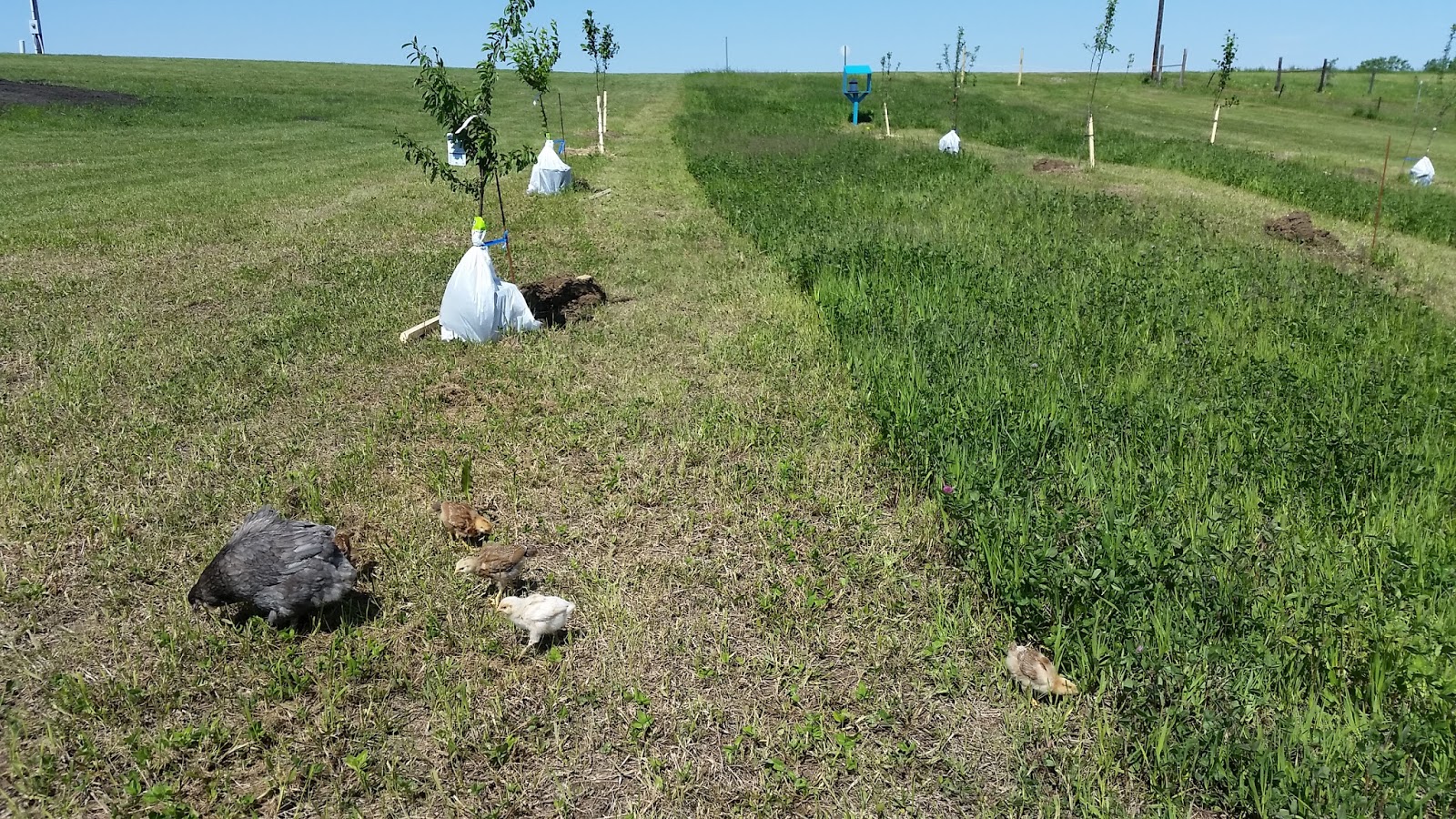
It was at this stage that I had an upper hayfield that now look like giant gophers from the planet Graph Paper had taken up residence, but alas I still had no trees. Count them. Go ahead, count them. There are 18 trees up there. As you'll remember from the coop building series, I don't have a pick-em-up truck. I have an SUV. Sure, I treat her like a pick up truck, but she has this pesky roof and this really nice interior that tends to get in the way of my projects. Notice I said "gets in the way", it certainly doesn't stop me. So, stripping out the truck of all non-essential mom things, and spreading out my truck blanket, armed with a box of kitchen trash bags and some twine, I was off to the local plant nursery. It took me two trips, but I now know I can get ten 8-to-10 foot trees into my truck. The nursery people look at me like I'm nuts, but I'm used to that!
 |
The survey crew and trainees making sure I was
doing it correctly. |
Once home, I spent the next few days widening the holes, adding loose soil mixed with native soil, planting, watering fertilizing, staking, and tying. The stakes are 2x2" cedar that I got from the trash pile at the local big box hardware store for 25 cents each. cut to 4 feet long and then at a 45' angle on one end.
The ties are tree
links, which are so VERY easy to use and adjustable. After a few days work, I could finally stand back and enjoy my orchard. It was at this point I noticed something a little off. One side of a cherry tree was missing. D'OH! The Deer! ( HA! Get that song stuck in your head now! Sorry. No I'm not.)
The little monsters had already found their was to the orchard! And by the little hoof prints in the mud they brought one of their limb munching progeny with them. I KNEW it was going to happen. I just hoped it wouldn't be this soon. I was tired and needed a project break. So three days before my birthday, I traded in my present, my dinner out, and my cake for electric fencing supplies. Hey, what geeky girl wouldn't want half a mile of wire, T posts, insulators, and horse tape for their birthday?! (I still need cake.)
Doc and I spent the next day making more straight lines and marking post holes. This time it was windy, BUGGY, HOT, and HUMID. Yay, what a change! Everything else I can do on my own, but getting that fence square took two people. I decided on a two-row, optical illusion fence. Deer can jump high OR far, but not both at the same time. Make getting over a fence an iffy proposition or difficult and they'll move on to easier food. The outer fence is a high visibility fence that is 6 feet high, and the inner fence is 36 inches away and a visible 4 feet high. To a deer, it looks like a place to get stuck in or on, and they move on. It is also hooked up to an electric fence charger 2,000 volts. They've tested it., I've seen the footprints - on the outside. So far, they haven't gone in.
I did decide to run a hot wire hook up to the ranchers' 10000 volt positive/negative fence for the summer (with permission of course). This will train the deer that this space is NOT to be messed with. If it makes a full grown cow jump, I should be having venison for dinner if they try.
There you have it. The orchard at the Station is in. It is doing well. The trees are leggy this year and suffering a little from cedar rust disease, but next spring before they come out of hibernation, I'll prune them properly and spray them. It will take me a few years to really get to enjoy it at its fullest, but I promise not to wear a white pantsuit and heels to harvest!