WARNING!!
All content on this website is copyrighted. Do not use any content of this website without our written permission, to include photos.


Thursday, September 3, 2015

Crazy Chickens

Let's face it, Chickens are Crazy!

If you don't raise them, or know someone that does, then this may come as a complete shock to you. But I'm here to tell you that they are downright nuts, their mother's had them tested, bonkers crazy!

Most people go about their daily lives seeing nice, normal, sedate tree birds, who happily perch on a delicate branch and belt out a nice tune, flit about the feeder and splash about in the birdbath. They joyfully collect sticks and bits from the yard, or the cat, and make lovely nests in delicately painted bird boxes or the protected crook of a tree.  We lift our children day by day to spy the little newly laid eggs, and soon the tiny chirping mouths.  Sure, zoo birds may be a BIT more interesting than the normal house wren, but by and large they too are "normal" acting creatures. 


I cut zoo birds a little more slack on the crazy meter as they DO tend to be exotics, and have to deal with the general population on a daily basis.  The exceptions to the crazy rule are mocking birds ("the notes are C,D,E, and A!" or being able to replicate a car alarm at 4am), hummingbirds (natures fierce, territorial, MEAN little fighter jets), and wild turkeys (not a brain in their head, unless it is hunting season and then they become the most clever of birdies.)

Chickens are a horse of a different color.  From the minute they start to develop in the egg, until the moment they see their last sunset, they are in an entertaining world of their own.  The little fluff balls get into all kinds of mischief all day and long into the dark hours as they explore their world.  They woo you with their intoxicating cuteness, luring you into a false sense of calm and security.  Then one morning you go out to the broody pen, and like a scene from Stalag 17, they've escaped!  They've been cleverly plotting for weeks until just the right moment.  In my head, I envision them standing on each other's shoulders, until finally they can reach the cage top, and then with one almighty push, they are free.  You spend the rest of the morning scouring the nooks and crannies of the barn, shelves, and storage bins for your innocent little fluffs before the giant wolf spiders haul them away to Gallifrey.


This little insight to their ability as escape artists leads you to build a much larger grow out pen in the barn.  Sure it takes up a lot of room, but they are growing, and maybe if they have enough space, they won't try to escape.  HA! Wrong.  They are hard wired to explore.  Like beagles, they follow their stomachs.  They could have the most incredible bounty right in front of them, but all they can think of is, "what's over there, and how do I GET there".

By now they have surpassed the fluffy adorable stage and have moved on to the ugly duckling phase.  This is when the pecking order starts to rear its ugly head, which can also be entertaining, in a Wes Craven kind of way.  You figure that boredom might be the instigator for the fights so you add enrichment items.  The thing is, like children, they'd rather play with the cardboard box than the toy.  Nothing you put in the pen for them to be play with, will be played with in its intended manner.  Swing perches become pecking toys.  Clamshell food puzzle balls get pulled apart and spilled so they can play with the worm like elastic band.  The interest inducing RED play ball you added for push and chase fun.... well, let's just say our rooster has a strong core and rock hard abs and the balancing skills of a Romanian gymnast.

We spend a ridiculous amount of time observing our chickens. I think it is there hypnotic plan to over throw, if not the planet, at least the homestead. I am nearly certain they are of alien origin, and if not, I at least have NO trouble seeing them as the once Giants that Ruled the Earth.  Instead of watching TV, or playing video games, or creating imaginary villages and waging warfare on our tablets, we drag out the lawn chairs and sit with a glass of ice tea and watch the chickens peck.  It is oddly entertaining and relaxing all at the same time.  We watch and wonder why they've wandered where they've wandered.  We are perplexed at their 90210 cliques and social drama.  We know their chirps and calls, and movements and stand bolt upright from the chairs when the flock suddenly flies from the lower hay meadow to the cover of the coop.  Was there a snake?  Did someone see a hawk?  Is there a t-rex sneaking up behind me that I missed?  Or did someone just get the urge to go bonkers and the others joined in?
Now that all of our ladies are in the big girl coop and are (for the most part) all laying.  The entertainment value has gone through the roof.  Their wanderings occasionally find a spring peeper frog.  Toads they leave alone, but a small frog is at the top of their menu wish list.
Not on the menu, EVER!
 Not only does it provide a great chase, but once one chicken has something, they all want it.  It could be an old muddy shoe, and if one shows interest, the chase is on.  The fun thing about a frog is that more than one chicken can enjoy it.  Bugs and worms can be used to taunt the other hens and quickly swallowed in one teasing gulp, but a frog?  They are stretchy and have four floppy limbs.  The great chase can go on for half an hour!  Then it is like watching 4 eight year olds play with a Stretch Armstrong doll.


Fair Game!
 This past week, I've been putting in extra hours in the garden as it winds down.  The late summer scourge of the high plains, the grasshopper, is starting to take its toll on the tomatoes.  I've been going out and picking the unblemished orange ones, and tossing the damaged red ones over the electric cattle fencing to the birds.  They know they aren't allowed IN the garden, so as I work inside, they line up like children against a  glass restraint window in a Dickens novel.  Their sad eyes and pout beaks pleading for a red, ripe orb all the while their Jedi mind tricks are trying to penetrate past the protective electric field.  It must have worked.  They managed to get a gallon of cherry tomatoes, three cucumbers, and a cantaloupe from me Tuesday night.  And of course no one could just EAT the food.  All of it had to become part of a game of tag.  There were tomatoes and chickens running flying all over the yard.

Another crazy sight, besides dust and sun bathing, is the invisible prey.  My henhouse is about a million miles from the house.  When you walk through the house completing all those pesky inside jobs, you can catch a glimpse of the bucolic scene of a flock of fat hens waddling their way across the lawn, mindlessly pecking and scratching for food.  Then it happens.  One of the hens will seemingly loose its tiny little mind and start bounding across the lawn, zigging and zagging, leaping, turning, up on her toes, crouched down like a pouncing tiger.  Moves that the Hippos from Fantasia could only dream of.  Of course they are all moves that would make a psychologist see dollar signs as he envisions his new multi-million dollar yacht.  Luckily, we don't use a pet psychologist (Yes, they DO exist.)  So what's up with the critter?  DO they even MAKE chicken straight jackets?  Should we skip therapy and go straight for the stock pot?

Butterflies.  Yup.  Teeny, tiny, hard to even see when they are right in front of you butterflies.  Or maybe they are moths.  I've never been close enough to one to look for fuzzy or naked antennae.  Just as I start to look at one, a hen will pull off the leap and spin of a life time, and poof, the bug is gone.  They must taste amazing.  Last night, several of them were chasing their own moths all at the same time.  It was starting to look like the insane asylum was open for business.

Fast forward to just before dark last night.  The temperature had finally started to drop from somewhere near equatorial jungle to volcanic sauna, so I decided that while the girls were out filling their crops before bed I would swap their old three hole nest box for their new 6 hole box! 

Old Box.  And yes, that is the rooster.  My young, poor confused
Rooster.

The Rolls Royce of Nesting Hotels
You would have thought I nailed a six headed alien to the wall!  It was like one of those reality TV shows where the couple leaves for the day, and friends sneak in and remodel the whole place.  The rooster was especially peeved, but as the sun was past setting, they calmed down quickly, roosted, and reconnected to the mother ship for a nights worth of recharging

Uh-huh.  It all started again this morning when they woke up to find a 6 headed monster nailed to the wall.  I watched from the glorious comfort of my Select Comfort Bed via our web camera, as the little biddies took their time going outside, and instead gathered around in front of the great beast like islanders in front of their Easter Island Gods.  Their chatter was incessant and finally the rooster had his say and they all migrated out to breakfast.  Hyacinth, always one to do her own thing (she eats paint too - well pecks it off - don't ask) decided to tame the mighty beast.  Although she isn't due to lay until around 3 today, she had to park herself in every cubby.  I think it was to determine which one was hers so she could prepare to kick someone out later
As I check in on them again, I see that someone has managed to tame the beast and lay an egg, and Daisy has decided that the new nesting pads are the bees knees and has fluffed herself an amazing nest!  So all is not lost! LOL. (The green pads are great as well.  They can be washed and reused for years and years.  The new ones you toss when they get excessively dirty, so weeks to months.)
 

See how entertaining they are?!  And YOU don't even have to feed them or scoop their poop!


Sunday, August 23, 2015

Farm Fresh Eggs

Eggs in the Icebox or Not?
The United States is one of the few countries in the world that keeps its eggs in the refrigerator.  In fact, in Europe, eggs can be found in their cartons on the shelf with other shelved items.  (I've heard tales from expats wandering the chilled section of European markets looking, dazed, for eggs.  When directed to the shelves, they reach toward the cartons, shaking, as if reaching towards a snake.)  In the US, the eggs from battery factories, must be processed within 7 days of being laid. By the time they are collected, and washed, packed and shipped to the market those “fresh eggs” from the local mega mart could already be two weeks old.  Then there is the time they spend at the market, two to three weeks, and then the time they spend in your refrigerator.  So “fresh” is a loose definition at best.
So what’s the deal? 
Eggs are permeable membranes, covered in thousands of pores.  When an egg, fertilized or not, is laid, the last thing that happens to it on the way out of the hen is getting coated in a natural sealant called a “bloom”.  It is this bloom that quickly dries on the egg and seals the pores on the shell, making it impervious to bacteria and reduces the loss of moisture from the egg.  Nothing gets in or out of the egg.  This bloom is meant to protect the young developing chick inside.  (Even a fertile egg will not develop on the countertop.  More on that later.) 
In the factory egg system, this bloom is immediately washed off, as well as any chicken waste product and/or waste from broken eggs from the production line.  Since the bloom has been washed and scrubbed off, with anything from acid to chlorine, bacteria is now able to invade the egg and moisture is allowed to escape from the pores.  As moisture leaves the egg, carbon dioxide escapes from the egg and is replaced by oxygen, which speeds up the deterioration of the egg.  The cloudiness in a new egg white indicates the presence of carbon monoxide.  As an egg ages, more gas escapes, making the white more clear and more watery and runny.  You’ve probably used a store egg, that was at or near the date on the package and noticed this change.  Since the egg’s security firewall has been removed, to protect the consumer from bacterial growth, the eggs are kept in cold storage, usually below 40’ to INHIBIT bacterial growth.  (Bacteria may still be present, but cannot thrive and reproduce or thrive on, or in, the eggs at those temperatures.)
ONCE EGGS HAVE BEEN WASHED, and the protective bloom removed, THEY MUST BE STORED BELOW 40'F to inhibit bacterial growth.

At DunRovin Station we store our unwashed eggs on the counter.  They are kept dry and cool.  Assuming you’ll be eating them within a couple of months, there is no need to refrigerate the eggs. (Not that they are ever around that long here, YUM!)  Even then, studies have shown that they are still safe to eat, they just don’t cook as well.  We only wash our eggs right before we use them.  Overly dirty eggs, do not make it to our storage shelf.  They are, hold your hat, washed in the barn, then cooked and crumbled with the shells and fed back to the hens.  Yes, hens are omnivores.  They will eat anything, including each other, if given the chance.  Our hens are open pen, free range happy hens.  They are only closed in, for their safety;  due to predators, weather, or for sleeping at night.  Otherwise they are happily wandering about the acreage, under the watchful eyes of Zap – the Rooster - eating their high protein feed, chasing grasshoppers and butterflies, and enjoying the occasional treat tossed to them over the garden fence.  It’s all that protein and greenery that allows our hens to create those bright yellow and orange yolks!
I can hear you now, “WAIT?! You have a ROOSTER?!  But I don’t want to eat a baby chicken!”  You aren’t.  Did you ever wonder how a bird can lay several eggs over several days, sit on them, and then have them all hatch on the same day without one being “over cooked”, some “undercooked”, and the others “just right”?  Here’s how it works.
Firstly, a hen does not need a rooster to lay eggs. When she reaches about 20 weeks old, she starts to lay about an egg a day, depending on the breed.  It may be every day, or every couple of days.  If she has no rooster, that’s all you get –just an egg.  If she has a rooster, she will still lay an egg, but this time, the egg has both sets of chromosomes.  If left undisturbed, she will continue to fill a nest box with her eggs until she has enough.  Then she will SIT on the eggs.  It is this process, called “going broody”, that allows the fertile eggs to begin to develop an embryo.  Not until certain, very specific, environmental conditions occur will the eggs even START to develop.  When the mother hen sits, she keeps the eggs at over 100’F, and her body heat and closeness to the eggs increases the moisture around the eggs to incredible levels.  She becomes a living steam bath for the eggs.  So while not all laid at the same time, they all start developing at the same time, and therefore, all hatch within hours of each other on day 28.  I promise our eggs at the station are kept nowhere near the conditions of a broody hen.
Remember the “farm freshness” we learned about at the beginning?  Well how fresh are our eggs?  We currently have 14 pullets and hens (hens are birds over 1 year of age, pullets can be of laying age, or not, but are under one year old), and one rooster (technically a cockerel, since he is less than a year old).  As of this writing we have 5 laying eggs almost every day.  So it takes us less than 3 days to get a dozen eggs.  Demand is high, so as I fill a carton, out the door they go! The time to fill a carton can be slightly longer when we have a girl decide to take a broody break, or the heat of summer slows them down, or the loss of daylight in winter slows them down, OR unless I get the overwhelming urge for a good fluffy egg soufflĂ© or such at home !  Soon all 14 SHOULD be laying, and those that want eggs, will not have to wait “their turn” for those jewel blue cartons to show up!
So if you decide to store your eggs on the counter, GOOD FOR YOU for stepping out of the (ice)box.  I won’t hesitate to tell you that it took a huge leap of faith and a great deal of research for me to get over that hurdle.  Old habits die hard.  Like I said, I wash my eggs right before I use them.  YOU MUST USE WARM WATER to wash your eggs.  If you are running your water and put your hand in it to test and can hardly feel it, the water temperature is 98’, make it warmer.  If you use cool or cold water, the membrane of the egg will contract and pull any bacteria on the outside of your eggshell to the inside of the egg, which defeats the purpose of washing your eggs.  I also use a drop of mild dish soap, like dawn, and teaspoon of bleach to 4 cups of water.  I mix the two in a bowl and take the eggs for a ride through, rinse them in warm water and let them dry on a plate, napkin, or other clean surface, while I prepare the rest of whatever I am making.
IF you decide to store your eggs in the refrigerator YOU MUST WASH THEM FIRST!!!! ALL OF THEM.  Following the washing and drying directions above and then place them in a CLEAN container in the refrigerator.  Do not reuse the old carton, which held the unwashed eggs.  We do NOT recycle our egg cartons, or use old grocery store containers.  Our containers are NEW and clean when we put our eggs in them.
“I cracked my eggs and there STUFF (or blood) in them!”  This rarely happens with factory eggs, but can.  It is more common in farm eggs.  Why?  Factory eggs are processed along a shockingly bright egg table.  Eggs that have meat spots or blood spots are either tossed in the garbage, or cracked and blended, and sold as prescrambled egg product for use in industrial settings or baking.  We do not light sort our eggs.  It’s a cosmetic thing.  The meat spots or blood spots will not harm you.  When cracking an egg, crack one at a time in a small bowl and then add that egg to your larger project.  Repeat with the next eggs.  If there are spots in the egg, and you WANT to remove them, you  can do so at this point with a spoon or fork. (It’s also a great way to chase bits of egg shell that get away from you.) 
“But what IS IT?”  As egg travels through the hen without the shell.  Amazing, but true.  It isn’t until near the end of the road, that the loose egg gets its final coating of calcium, and sometimes color (which we jokingly call the paint sprayer).  The meat or blood spots are simply harmless bits of the hen’s reproductive tract that got caught up in the encapsulation process.  This is also how you can end up with a double yolk egg.  Two eggs are released at once and contained in one shell.  These eggs are removed from the factory process, to protect our delicate consumer mindset.
“I made boiled eggs from your eggs, and they won’t peel!”  Yes, I know.  Shockingly enough, I still purchase store bought eggs.  These are for the SOLE purpose of making hardboiled eggs.  FRESH eggs hold tight to the inside membrane, and are low in water content.  OLD eggs, have a higher gas content and water content, and have looser protein strands and will boil and then peel.  Even an OLD farm fresh egg is nowhere NEAR as old as a store egg.  So when the hankering for egg salad, potato salad, or (DROOL) deviled eggs calls, I pull my store eggs from the refrigerator. Besides, farm eggs are SO amazing in dishes that feature eggs; like scrambles, quiche, soufflĂ©, over easy, eggs benedict, over hard, etc, you’ll not want to waste them on boiling and mayonnaise!  Cakes and cookies?  SURE! But a deviled egg?  Nah.
“My eggs cook faster than they used to!”  Fresher eggs have less water in them.  You aren’t having to heat the water in a scrambled egg or fried egg before the egg starts to cook.  Fresh eggs DO cook more quickly than OLD eggs, so don’t wander from the stove! (As always, completely cook your egg product for food safety.  And do not eat raw egg product.)
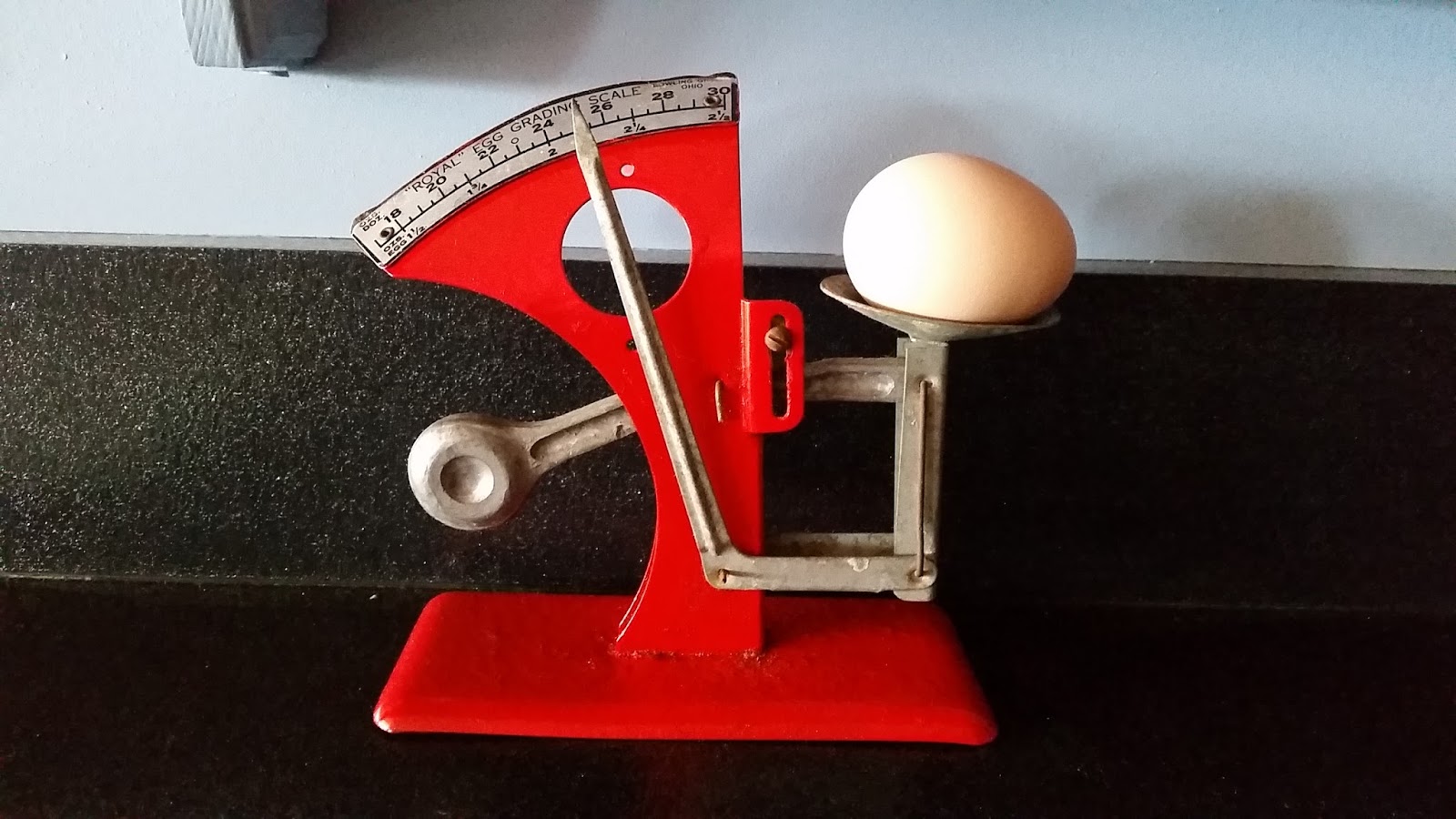
One of the things I LOVE is when a person first opens one of our cartons for the first time is the “OOOOs and AHHHs” of finding a rainbow of color inside.  That’s all the goofball breeds of chickens we have.  We do not dye the eggs.  The chickens do!  It comes down to genetics.  Between all of our silly breeds here, our eggs range from the palest of pinks, tan, beige, sand, milk chocolate, chocolate, dark dark chocolate, olive green, and baby blue.  We fill our cartons as the girls lay them, so we cannot promise colors.  Each carton is hen’s choice.  This also includes grading or sizing of the eggs. 
Most of our eggs are in the larger medium size to large, to extra large in size range.  Again, it’s hen’s choice. We do hold back our tiny eggs from our new layers, until they start laying larger eggs.  The eggs in the carton can be used interchangeably in recipes.
We are not a commercial farm or business.  We raise chickens for fun and entertainment.  The eggs are a bonus.  The cost of a dozen eggs goes towards the cartons and their feed.  There is no way we could ever turn a profit on these critters or their eggs.  But we love caring for them and being able to share the fruits of everyone’s labor!
Please wash and store your eggs properly.
Happy Baking!
The DunRovin’ Girls:
Olive - Olive Egger -olive eggs
Hyacinth - Lavender Irvington - cream eggs 
Meriwether - Ameraucana - sky blue eggs
Nugget- Slash Maran - Dark Chocolate eggs
Violet - Blue Laced Red Wyandotte - pale pink/buff eggs
Daisy - Light Sussex - light brown eggs
Rose - Welsummer - light brown eggs
Leela- French Blue Copper Marana - Dark Chocolate Brown eggs
Flora- Black Ameraucana- sky blue eggs
Lucy& Ethel - Copper Marana - Dark Chocolate brown eggs 
Donder & Blitzen - daddy is a blue egg Ameraucana and mommy was a Red Leghorn light brown, So I call them American Reds-  blue/green eggs
 
Cirrus - Daddy blue eggs Ameraucana mommy was a Buff Orpington light brown. I call her an American Orpington - light green eggs? 
 
ZAP the Rooster - French Blue Maran

Saturday, August 22, 2015

The Hoosier Cabinet

The Hoosier Cabinet is a generic term used to describe a free standing kitchen, or pantry, cabinet with multiple storage cabinets and an enamel counter workspace at hip level that is able to be pulled out to enlarge your workspace.  Fancy versions could have decorative window panes, flour sifters, sugar and flour storage, spice racks, rolling pin holders, recipe storage and handy baking tips on the insides of the doors. 


When/IF you can find them at antique stores, or sometimes a barn or estate sale, their price runs anywhere from insane to ludicrous.  Their condition runs the gambit between a pile of wood scraps, a cabinet that is 6 inches larger in every direction due to a million coats of paint, and near pristine (or even newly made copies, distressed and being sold as antiques).

I have ALWAYS wanted one.  As far back as I can remember, I have wanted one.  I must have had a great, great aunt that had one in her kitchen, and it is hidden deep in some corner of my good memories.  I think they are wonderful.  There is just something so incredibly fascinating about them.  They represent creativity, thrift, hard work, craftsmanship, and home and family.  The catch was, as they are antiques, there is no way one would ever survive being moved frequently.  Compounding the issue was never finding one that was in decent enough condition that had a price tag that didn't send my eyes rolling.

Until this April.

I have been visiting Liberty House Antiques about every one to two weeks for the past year.  Not only is it an amazing Victorian era home used as a bed and breakfast, but it is also a fabulous antique store.  Pat, the proprietor, has the antiques in the appropriate rooms of the house (kitchen items in the summer kitchen, clothes in the closets, etc).  There are also amazing nooks and crannies that hold little treasures if you have the time to look. She is constantly bringing in new items, and is always willing to keep an eye out for things you collect while she is on the road hunting.  Anyway, one Spring day in April, I noticed a set of fiesta teacups on a shelf.  Then it dawned on me that the shelf was in a cabinet, A HOOSIER CABINET. 

The cabinet was always open so you could things displayed on the shelves for sale, and the counter was covered in items as well.  I had never noticed it before for what it was!  It was in really decent condition, so I didn't even BOTHER looking at the price tag.  There was no way this thing was less than $500.  So I just kept going through the shop, shoving the image of the cabinet to the back of my dust bunny filled brain.

Fast forward to the end of July.  I was visiting the shop again and decided, just for giggles, to check the price of the cabinet.  I moved items around looking for the tag until I found it.  $125!  I quickly started going over the whole piece, looking for missing pieces, broken wood, missing legs, broken hinges, anything that I couldn't fix myself or easily replace.  There was nothing that was so major that I couldn't handle.  The hardware wasn't original, and judging by its design was from sometime in the 60s,  The interior, at some point, had been sloppily painted a dark Hershey bar brown, but the wood, for its age, was in great condition, and the counter was almost pristine - no chips in the enamel, the roll top door (the tambour) on the utility cabinet needed repaired, but that would be easy.  I couldn't get that cabinet paid for and loaded into my truck fast enough!

(I forgot to take a photo of it IN the shop.  Silly, over excited me!)

Once I got it home ( I had to take it apart into its three pieces to get it in the truck), I looked up reproduction hinges online and quickly tossed that idea out the window and went local.  All this cabinet was a cleaning, light sanding, staining/sealing, and that Hershey brown had to go.


I selected Rustoleum high gloss Wild Flower Blue for the inside, which is a shade lighter than my kitchen walls.  This illuminated the interior by leaps and bounds.

The stain is Olympic stain and sealer in one, made for decks, and I chose semi-transparent Canyon Sunset.  A warm deep brown.  The more layers that went on, the more rich the stain became.

The inside of the utility cubby, which I would leave open for display would be painted Flat Navy Blue.

The flour dispenser/sifter, I chose Rustoleum High Gloss Candy Apple Red!

Several trips to area hardware stores finally revealed the hardware that I had in mind, library cup handles in flat black.

Then, the work began.  The first task was to tackle the cleaning.  Almost a century of grime had to go.  OF COURSE I decided to start this project on the hottest week of the summer!  I vacuumed out glitter, crumbs, and dead bugs.  The cabinet then had a good scrubbing with Murphy's Oil Soap, and then had a good rinse down.  Even just washing the cabinet, seemed to bring the cabinet to life.  All the hardware was removed, as were the doors and drawers.  I allowed it all to dry for two days before continuing.

It was during this cleaning that I found the original shipping labels and price tag, which was written in oil/grease pencil on the backs of the pieces,  Sears and Roebucks, Nappanee Cabinet, $25.95!

I digress.  It's the paint and stain fumes.

With the cabinet now dry, I lightly sanded all the surfaces and wiped them down with a tack cloth to remove the dust.  I taped off all the area where the painted and stained surfaces met, and then proceeded to paint the interior.  I also painted all the hinges flat black and the flour sifter.

Two coats of paint later, and a wicked spray paint, heat exhaustion sinus headache later, The painting was done.  I decided, due to the high humidity, to allow the paint to fully set up for two days before tackling the staining.

The staining really went quickly.  I managed 4 coats in a day.  With each layer of stain, the color became more and more luminous.  I couldn't wait for it to dry so I could put it back together and get it into the kitchen and start filling it with canned goods.

I allowed the stain to set for a full 24 hours before carrying it, piece by piece, into the kitchen to reassemble there, in the cooling, arctic breezes of the Air Conditioning.  It took me two hours to put her back together and get it set up.  I lost track of the work hours. The supplies; paint, stain, and hardware, came to $100.  I still got a deal!

She's BEAUTIFUL!

The lower cabinet still has the wire shelf in it, but I made a 7/8th" thick, stained to match, wood shelf, to store quart jars of tomatoes. The wire shelf just isn't strong enough to take the weight.  The drawers hold canning supplies.  The bottom drawer is a tin lined bread drawer with a sliding lid and holds all my rings.  The middle drawer is divided and holds my citric acid, fruit fresh, tongs, lid lifter, and the boxes of flat lids fits perfectly in each cubby.  The top drawer holds odd cooking utensils.  The rest is self explanatory. 

I like to think she's happy again to be loved and useful and clean and new again.

Friday, August 21, 2015

Summer "down time"

Ok, ok...

I am shamefully hanging my head.  I realized I had not posted on the blog in three weeks.  To my credit, I simply cannot believe it has BEEN three weeks!  I do not know what has happened to the calendar block we CALL summer, but there you have it, it's gone.

It seems like just yesterday school was letting out, the first of the corn rows was popping up, and the cicadas were just gearing up to full song.  At some point, late July and early August became a flurry of activity.  With temperatures becoming unrelenting and hovering near 100' everyday, and the humidity hovering daily between tropical rainforest and visiting the underbelly of a submarine, days became all about survival.

 Keeping the flock alive and happy was not only a priority, but a major undertaking.  They required a ridiculous number of trips to the coop, making sure they have not only water, but COLD water.  The amount of water a chicken goes through when it is hot out is INSANE!  We filled their 2 gallon waterer at least twice a day, and refreshed it with giant one gallon sized ice cubes made in the recycled lids of plastic bakery containers.  We made sure they had cool fruit and we would toss in frozen peas for snacks. ( We call them vegetarian pill bugs. Greenbeans are vegetarian grasshoppers.)  I also installed a huge barn fan in the front coop windows. 

The coop vents really quite well, until it hits 100' AND the wind stops.  The wind on this hill NEVER seems to stop blowing, until the heat rolled in.  We also decided that letting the girls out to free range, and find their own spot in the yard that was comfortable, was a lower risk than keeping them cooped up in the heat.  It turns out they love the dirt under the coop, especially when half of it has been sprayed down with water.  They can dry dust bathe  and settle into the cool earth on one side, or dig and splash in cool mud puddles on the other.

It was a long three weeks of catering to chickens, but everyone made it.  Three more girls actually started laying eggs as well. Nugget, our Splash Marana, lays the most delicious looking deep chocolate colored eggs and has worked up to almost large size eggs.  Violet, our blue laced red Wyandotte, with her still small terra cotta eggs.  Then there is our mystery layer.  Two days ago, small dark chocolate eggs started showing up in the nest boxes.  So it either belongs to Lucy, Ethel, or Fauna, all of whom are Marans.  But all are too hard to differentiate on the web cam.  My bet is on noisy Ethel.

Chicken Story of the week, since so many of the readers here love the chicken antics.  Zap, the rooster, is still quite young, but he's feeling his oats.  When he gets it into his mind that he want to mate one of the hens, he is all focus.  He picks a hen, and the chase begins.  IF she's in the mood, she will quietly sit, do the deed, he'll wander off, and she'll get up and ruffle her feathers back into place.  We call the whole process "feather ruffling".  Anyway, one day ZAP decided to go after Ethel.  Well, it being 100' Ethel wasn't in the mood.  (Who can blame her.)  She took off racing across the yard, screeching for all she was worth, with ZAP close behind, wings out, head down in full chase. She bolted for the run ahead of him and jumped in through the pop door and into the coop, and then stood still and quiet in the doorway.  ZAP, being focused on the chase, didn't catch her lightning quick turn into the run and coop, and thought she had run behind the whole building.  He ran behind the run and UNDER the coop, and stood there with a most bewildered lost look on his face.  I swear I could hear her laughing.

He got her back yesterday though.  We had three inches of rain in two and a half days.  Needless to say, the run and yard were a drippy muddy mess.  The area where we stand outside the run door had very large mud puddles.  I was in the run raking mulch, when I heard a commotion.  I looked, and there was poor Ethel being shoved deep into the mud and water by ZAP.  How's that for a gentleman?  Not even a cape to stand on.  When she got up, she looked like a drown rat.  That's a fine how do you do!  Roosters, ugh.

We were also attacked by the garden.  When you have warm summer nights, plenty of rain, and a good supply of sun and fertilizer, well, you get plants, BIG plants, and quite quickly.  To date I have pickled 50 pounds of cucumbers (various forms of pickles and relish), 10 pounds of banana and jalapeño peppers (pickled for subs and sandwiches), and have canned a whopping 75 pounds of tomatoes!  Holy Mason Jars batman! Tomato season hasn't even STARTED in full yet!  I'm up to my eyeballs in tomatoes! And glad of it. 

You never know when a tomato season will go bust.  Tomatoes are picky. The love hot and humid, but not too wet.  They really love humid hot nights.  IF any one of those things isn't up to par, your harvest will suffer.  Disease is also an issue.  So far I've had no disease problems.  But our nights haven't been as hot as I'd like, but we'll get there again.  It does give me a chance to kick back and take a tomato purĂ©e break!


I

I also managed to find a wonderful Hoosier Cabinet at the Liberty House Antique Store.    It had some wear on it, but was in generally good condition and had never been painted.  The enamel counter was almost pristine.  I have always wanted one, but they can be so ridiculously expensive.  I'll have a whole post on its rehabilitation.  But I am filling it to the brim with canned tomatoes, which I prefer to keep in the darkened cabinet. (Which is why there aren't any in the glass cabinet photo above.)

Garden update. 

The corn was a bust.  It never grew taller than 5 feet.  It was bleached from too much rain and not enough nitrogen.  I never sprayed, so we got worms and bugs.  The ears were small, but the chickens enjoyed them.  I will not bother with corn again next year.

The green beans were a dud.  My composted black soil is too rich, and all I really got were greens and very few beans.

The cucumbers, as I said above, were very prolific, until just last week, when the squash beetles found there way into the vines.  But that is fine.  I had plenty from those three vines.

The sweet potatoes and cantaloupe are merging into one giant plant, which I am sure will take over the planet.  We've had two gorgeous, delicious melons so far, and many more are sitting there hiding from the beetles.  The sweet potatoes, mercy, I hope they are super, as the vines are everywhere!

The Yukon gold potatoes are starting to die back, so harvest is just around the corner on those.

The sorghum is 10 feet high.  It suffered in a wind storm two days ago, but I have it bundled and tied to the fence.  I hope that will save it.


The orchard is struggling.  The high heat, high humidity, and low rainfall have done its worst.  Three trees, which were struggling upon purchase have died, and will be returned for replacements in the Spring.

Well there you have it.  The great update.  Tomorrow we will carry on to more of the FUN stuff!

Wednesday, July 15, 2015

Product Review - Rendr and Bee Sketchbooks and Graphik Line Painter Pens

First off, let me state that all reviews of products are my own personal opinion and experience.  The products reviewed are paid for out of my own pocket, unless otherwise stated.  Trust me, if anyone ever sends me anything to review, I'll certainly let you know.  Regardless, I will give you an honest opinion of my experience with the item.

That said, let's dive right in.

I found myself with a little bit of free time this week and decided to make the insanely long drive to the local Dick Blicks.  I haven't been for 18 months, as it is not only a long drive, but in a place that is a royal pain in the neck to get to.  Plus, I find them priced high, but they are the only game in the eastern third of the state.

I was excited to find a supply of new sketchbooks, which is something I will not purchase without putting my hands on it.  I want to feel the cover and the paper and test the binding.  I purchased a Bee Paper Company Professional Series Super Deluxe Spiral Bound, 9x6 in book.  The 93# paper feels great and says it is ok for wet and dry media.  I don't usually purchase spiral bound, as the spirals tend to smash or catch in your bag, or come undone.  It does allow for the book to lay completely flat, which means you don't have to fight the pages while you work.  The cover and backing are very heavy duty cardboard and support the book well.


I tested it with several pens and water wash and was very pleased at the reaction of the paper.  Only the sharpie marker, when held on one position for 8 seconds feathered and bled through the paper.  All other pens and washes remained on the working side and did not feather.


However, the wet media washes, did cause the paper to warp.  Upon drying it stayed that way.  It would have been a far more deluxe, professional sketchbook if they would have cut the 60 sheets down in number and increased the paper weight to combat that problem.

Near the checkout, I saw a turning tower of pristine black, hardbound journals, RENDR by Crescent.  I asked the cashier about them and she just raved about them. I balked at the $17 price tag for a 8.5x5.5 inch, 48 sheet book, but all in the name of science and art.  It boasts an all media rating, 110 # paper, and is acid free.  It also boasts that you cannot bleed through to the other side of the work, onto the back.  This makes all 48 sheets usable.  Online reviews of users say otherwise, but I thought I'd try it.  Challenge accepted.

When I got home, I cracked open both books.  I was immediately annoyed with the binding.  Forget laying flat, you have to fight to keep it open.  (Book lovers, turn away now.) You must break the spine at each page to work with this book.


The cover is oddly soft.  The material it is bound with is hard as a rock, like a textbook.  It's the covering that is odd.  It feels like waxy or greasy leather.  It's just odd.  It also mars easily and absorbs the grease off your hands.  Fingerprint end up everywhere quickly.

The paper feels like heavy duty copy paper.  It has little to no tooth.  Rumor has it that there is some kind of plastic between the layers to prevent bleed through, but it tears easily.  Although I was able to easily separate it into two layers, like two ply toilet paper,

On to the wet and dry challenge.  This paper turned out to be a nightmare.  It may not bleed through, but it is so absorbent that pigment or inks go where they want to, which isn't necessarily where you want it to go.  I tested the paper with a standard fountain pen, a uniball gel pen, a sharpie fine line marker, a micron brush pen, a micron .01 pen, and the new Graphik Line Painter pen (review below).


All the marks are lovely, but the paper is JUST TOO ABSORBANT.  Wet media just feathers like mad.  I did not have an issue, like other, with water media warping or bubbling the paper.

I did a squiggle test, line test, word, and then a dot test, where I held the point of the pen in one spot for 8 seconds.  The larger the dot, the more ink the paper was sucking from the pen.  The more fluid the ink, the faster it moved.  This property is also reflected in the start and stop points when you are writing.

All in all, I give it an, "EH" rating.  I was just too pricey to have to tiptoe around what materials work well and which don't with a sketchbook.


Neither book rings all my bells, but they are nice books.  For now I'll stick with the ones I make myself out of quality paper.


Interestingly enough, the Graphik pen did not flow and flow its ink out
when it was held in one spot for8 seconds.  Unless it was moving, the ink
did not flow.  I expected this paper to suck ink from that pen like a vampire
at a blood bank!
====================================

Now for the Grahik Line Painter Pen.

I LOVE pens.  In fact, one of my favorite websites is Jet Pens.  They get in all these amazing pens that you don't see anywhere else.  I have quite the writing instrument collection!  Anyway, near the register (I know, I buy candy bars on the way out of a store too.) Was a new display of shiny, plastic wrapped pens in a myriad of colors. 
 

Some of the pens were permanent, alcohol based pens, comparable to the micron line of pens.  The other end of the display held water soluble ink markers, which are permanent when dry!  Well that certainly sounded promising!   Draw and sketch and then go back and hit it with a wet brush or water brush and bleed and shade! SOLD! You could purchase individual pens or sets of pens.  The sets are numbered and contain different colors per set.  (I selected the .5 black.)

The pen puts down a thick, solid black line and was VERY smooth.  I was impressed.  I did a little doodle and went to the kitchen to fill my water pen.  I put pen to paper and... nothing.  It didn't do ANYTHING.  HUH.  I wondered if I grabbed one of the alcohol pens.  I checked.  Nope.  Hmmm.


I drew another quick doodle and immediately hit it with the water.  Woosh.  There we go.  But is only feather a little, like tiny trees reflecting on a smooth lake edge.  I was not impressed.  What if I put  down a really wet puddle and touched the pen to it?  It was pretty.  The ink flowed freely from the pen, creating a swirling oil slick looking effect on the water.  But what would it look like when it dried?  And HOW LONG would that take?

I decided on something in between.  Really wet paper, but not soaking.  I still couldn't drag enough ink from the line.  The same with drawing and moving with water. It all seemed hit or miss. 

Conclusion, this is definitely a special effects marker, NOT your go to water soluble sketchbook marker.  And yes, it stays put when dry.  Disappointed?  Yes, but I'll still find a home for it in my bag.

Wednesday, July 1, 2015

The Orchard

I love apples.  They don't necessarily love me, but most raw fruit doesn't.  That doesn't keep me from breaking down every Fall and driving to the local U-Pick it farm.   Picking apples has been fabulous everywhere we've lived, except Florida and North Dakota.  The blueberries in Florida were wild, and you purchased a permit from the local park system and made sure you carried a bear bell, so you startled the bears away, before they startled you.  (At least that was the theory.)

 In Alabama, we were up to our eyeballs in peaches.
Not only am I allergic to eating peaches, but I am also allergic to their fuzzy little hides.  Sigh.  In North Dakota, the winter's are hard on apples, but great for fruits and veggies, unless you've planted your orchard in a protected coulee.  Everywhere else, it's been apples, apples, apples.

I grew up in apple country.  In grade school, we used to take day trips to the local historical park, pick apples all morning, start a giant cast iron kettle of apple butter, and learn to carve apple head dolls, while sipping tart cider, and singing apple songs.  Back when going to the orchard was less expensive than going to the grocery, my family would make trips to the orchard to pick varieties as they came available, some of my best memories EVER!  You wore your working clothes, loaded up on highly toxic bug spray that made DEET look like sugar water, tossed a bandana on your head so that ticks had a really GOOD place to hide and dig in, a thermos full of water and a peanut butter sandwich, lugged bushel baskets down the rows and placed them under your trees and started climbing. 


Not only did you pick apples, but you ate as you went, and no one cared.  The kids giggled.  Mom and great grandma told stories, and chatted, and at the end of a sweaty day, you loaded your bushel baskets into the back of the station wagon, paid the man and drove home, your torn clothes, muddy knees, and sunburned everything - a badge of honor for an honest workday of harvest.  We'd store the apples in a dark corner of the cellar.  Our guts so full of apples we'd swear you'd never look at another, let alone EAT another apple every again, usually as we were munching on yet another apple on the way up the steps to the shower.

 As adults, we lived along the Johnny Appleseed Trail, twice.  Sadly, the orchard experience is no longer the same.  Varieties are no longer of the hearty, flavorful heirloom varieties; Cortland, jonathan, granny smith, russets, winesap, the nonesuch, empire, or the orange pippin.  Many don't even have names because there is only the one old tree in grandma's yard that no one knows WHAT it is.  Now orchards are trending towards the magical genetic designer world of fancy apples; pink lady, Ambrosia, Alexander, The Grapple, Honeycrisp,  Zestars, Freedom, Lodar, Pinova. and Cameo.  There is nothing wrong with the newer varieties, heck, I'm first in line when Zestar is ready to pick.  They are bred to be more disease resistant, drought and moisture tolerant, take handling and storage better, and just be a better apple for today's market.  My problem is that the orchard experience is gone.  For one the price has gone through the roof.  Many times it is far more expensive to go pick the fruit that it is to buy the beaten up old storage fruit that arrives at the grocery.  When listening to visitors at the orchards I hear them reason, " well I'll pay more because it's fresh" or "part of the price is the experience of it all".  (Sigh and a sad giggle.)  The last time I was there, it was an honest-to-goodness nut house.  (My sister shares the same experience, but from an orchard over 1200 miles away.)  They have become a place for urban dwellers to bring children for an hour and pick apples.  Read that as:  tear branches, toss fruit on the ground when they see a bug, have a complete meltdown when they step in mud or a piece of rotting fruit, throw fruit at each other, or otherwise act like escaped zoo animals.  For the most part, the adults are no better.  Sure, there are a few of us who show up to get a season's worth of fruit to put up, but precious few. 

Last cherry season, not the cleanest of the orchard fruits, there was a woman there with her children and her husband who looked like they popped out of a J-Crew catalog.  Mom was in a white pair of slacks and was wearing heels...to a muddy orchard.  We had to hold the hay truck for them, while the husband was sent back to the SUV to get something for everyone to sit on as "hay is SO filthy."  You could hear the mom screaming at the kids across the whole orchard as they misbehaved and (shocking) got dirty.  The dad was having fits because there was no cell phone service "in the middle of this forsaken place."   Imagine what they looked like at the end of an hour picking cherries- juice dripping out of the bags they carried, down their legs, into their shoes.  I had to suppress giggles by popping fruit in my mouth on the ride back to the car.  I can only imagine them getting that hot mess into that pristine truck. It still makes me giggle. 

The little pay booth is long gone.  You know the type.  The rickety old cedar board shack that was little more than a two hole outhouse, minus the seating.  It was more or less for shade for the old man, the one who helped Noah load the ark, who worked there.  It usually had a little counter full of small bags of apples for those who just wanted to buy some as they drove by.  If you were really lucky, there might be a couple of pies there for sale made by Mrs Old Noah's Helper.  The cash box was a simple metal affair with a little metal handle, or was a plain cigar box.  In a few places we lived, there was just a little bench with an honor box: no attendant, no lock, just a rock to keep the whole thing from blowing away.  The little old man and his wife are long, long gone as well.

It's all been replaced with modern buildings that are markets in and of themselves.  They sell everything from jams and jellies, to pies, cakes, cookies, cider, soda, hamburgers, nachos, packaged meat, jerky, and fudge. Precious little of it made from scratch or at the orchard or from its bounty.  Blaring music from local bands screams from loud speakers on decks and porches, drowning out the crickets, cicadas, birdsong, and breezes blowing through the branches.  No longer does a large kettle simmer with the golden sweet aroma of apples and cinnamon, as it is drowned out by the propane jet cooking batches of kettle corn to supply the agri-tourists on their trips back to town, but only after they've spent the afternoon "tasting" wine at the wine counter.  The orchards even have massive displays of pre-picked fruit, of all varieties, just in case you've driven two hours and still don't want to get dust on your shoes.

I'm not usually one to wax poetic about "the good ole' days", but dag nab it, this is one of those things that's been ruined.  You many as well go the grocery store! Even the mom and pop orchards are leaning towards the tourism thing as apparently "that's what the public wants."  My favorite tiny local place here now sports a slushy machine next to the cash register.   I guess the way it was, is the way it WAS, and will never be again.  It's sad that kids will think that this is the way a fruit farm is.  Yes, I still go to the local fruit farms.  My trees are still babies, and if I want to put up cherries, apples, apple pie filling, juice, cider, blueberries, raspberries, (DROOL) apple butter, and apple sauce, etc. I'm just going to have to KEEP going for a few more years.  But I do try to go before everyone else gets up and going, and certainly not on a weekend, or during an orchard promotion party.  I'm certainly not knocking any of my u-pick orchards, but gracious, you just have to prepare yourself for a shopping and sociology adventure when you go!

So, back to MY orchard. 

For the first time, I not only had the space, but the TIME to start an apple tree and, pardon the pun, stay around long enough to see the fruit of my labor.  We've left a forest of trees behind us.  Every single place I've lived, I've planted trees.  Like the pioneers before, I like trees.  Besides our children, it is pretty much the only living thing that we can do that will outlive us, and give enjoyment to future generations, standing tall and silently bearing witness to history.  You've already read my entry about the adventures of older shade trees. Well, now it's apples.  Juicy, delicious, pectin dripping orbs of late summer delight. 

Most people don't know there is a trick to apple trees.  They need other apple trees, pollinator buddies I call them.  Think of them as field trip buddy.  You stick with your buddy, share lunch with your buddy, and hopefully you both make it back on the bus and make it back to school.  If you want your apple tree to produce the apple it was bred to produce, you need to make sure that somewhere nearby, there is a compatible pollinator.  This is usually a tree of a parental ancestor to that tree, but can even be a crab apple tree.  (This is also true of other fruiting trees.)  Sometimes the nursery stock will tell you right on the tag which other varieties you need to have, other times, you are on your own.  I find http://www.orangepippintrees.com to be a ridiculously helpful site.  It is mobile friendly, so it is right there in your pocket while you are shopping. 

I made sure I selected varieties that were not only on my checklist, but were suitable to this area.   I also had to be able to get ahold of these varieties.  After the great "Arbor Day Foundation" experience, I was back to square one.  I drove to many local tree nurseries and selected my varieties; yellow delicious, early harvest, red delicious, state fair, zestar (yay!), Haralson, MacIntosh, and Wolf River.  I had the trees.  I had their pollinator buddies.  I had the space, or so I thought.

My plan HAD been to plant them in the flat land of the lower meadow.  In summertime, they would have the full benefit of the full sun, and the slow runoff from summer rains to feed them.  In the wintertime, they would be out of the howling, freezing winds, being protected by the valley and the hedgerow of large old growth trees and shrubs on the cattle fence.  But one morning, before planting, I spotted a problem with that location, or rather, a whole HERD of problem.  It seems that a small herd of whitetail deer also like the shelter of the hedgerow, and use it for their nightly napping.  The game camera confirmed this in spades.  Even mowing down the high prairie grass hiding holes didn't deter them. So it was on to plan B.

I opted to move the whole party to behind and uphill from the barn.  I could reach it with the irrigation system if I needed to, admire it from the house,  and it would be - hopefully- close enough to people to deter the giant, four legged eating machines.  That having been decided, I sat down to figure out what tree needed which pollinator buddy.  That ended up looking like this...

I had the variety, number of trees, and the bloom time noted.  The arrow points to the variety needed for successful pollination.  MacIntosh is just about my least favorite tree, but since everyone seemed to like being its buddy, I bought one.

I now needed to figure out WHERE in the orchard to plant them.  I wanted to make sure everyone was within handshaking distance of their buddy.  That ended up being a game of cards that looked like this...


 Next was the really fun part.  I needed Doc to help me grid out this mess.  The trees needed to be 20 feet apart, the rows 20 feet apart, and we, absolutely had to do it on the windiest, coldest day this spring.  OK, that last bit was just a bonus. Because there isn't quite anything as fun as trying to manage a 100 foot tape measure on a windy day, wearing gloves, and trying to mark SEVERAL straight lines, dig holes, and rows.  We set aside an hour to do it, it took three.  Two engineers, one tape measure, two ideas on how to do things, the cold, and a shovel.....uh huh.  Needless to say, all the lines were marked, the holes dug, and Doc isn't IN one of them. (We actually DO work really well together, as long as we aren't hungry, or tired, or forget to communicate. LOL)

It was at this stage that I had an upper hayfield that now look like giant gophers from the planet Graph Paper had taken up residence, but alas I still had no trees.  Count them. Go ahead, count them.  There are 18 trees up there.  As you'll remember from the coop building series, I don't have a pick-em-up truck.  I have an SUV.  Sure, I treat her like a pick up truck, but she has this pesky roof and this really nice interior that tends to get in the way of my projects.  Notice I said "gets in the way", it certainly doesn't stop me.  So, stripping out the truck of all non-essential mom things, and spreading out my truck blanket, armed with a box of kitchen trash bags and some twine, I was off to the local plant nursery.  It took me two trips, but I now know I can get ten 8-to-10 foot trees into my truck.  The nursery people look at me like I'm nuts, but I'm used to that!
The survey crew and trainees making sure I was
doing it correctly.

Once home, I spent the next few days widening the holes, adding loose soil mixed with native soil, planting, watering fertilizing, staking, and tying.  The stakes are 2x2" cedar that I got from the trash pile at the local big box hardware store for 25 cents each.  cut to 4 feet long and then at a 45' angle on one end. 

The ties are tree links, which are so VERY easy to use and adjustable.  After a few days work, I could finally stand back and enjoy my orchard.  It was at this point I noticed something  a little off.  One side of a cherry tree was missing. D'OH! The Deer! ( HA! Get that song stuck in your head now! Sorry. No I'm not.)

The little monsters had already found their was to the orchard!  And by the little hoof prints in the mud they brought one of their limb munching progeny with them.  I KNEW it was going to happen.  I just hoped it wouldn't be this soon.  I was tired and needed a project break.  So three days before my birthday, I traded in my present, my dinner out, and my cake for electric fencing supplies.  Hey, what geeky girl wouldn't want half a mile of wire, T posts, insulators, and horse tape for their birthday?!  (I still need cake.)

Doc and I spent the next day making more straight lines and marking post holes.  This time it was windy, BUGGY, HOT, and HUMID.  Yay, what a change!  Everything else I can do on my own, but getting that fence square took two people.  I decided on a two-row, optical illusion fence.  Deer can jump high OR far, but not both at the same time.  Make getting over a fence an iffy proposition or difficult and they'll move on to easier food.  The outer fence is a high visibility fence that is 6 feet high, and the inner fence is 36 inches away and a visible 4 feet high.  To a deer, it looks like a place to get stuck in or on, and they move on.  It is also hooked up to an electric fence charger 2,000 volts.  They've tested it., I've seen the footprints - on the outside.  So far, they haven't gone in. 

I did decide to run a hot wire hook up to the ranchers' 10000 volt positive/negative fence for the summer (with permission of course).  This will train the deer that this space is NOT to be messed with. If it makes a full grown cow jump, I should be having venison for dinner if they try.

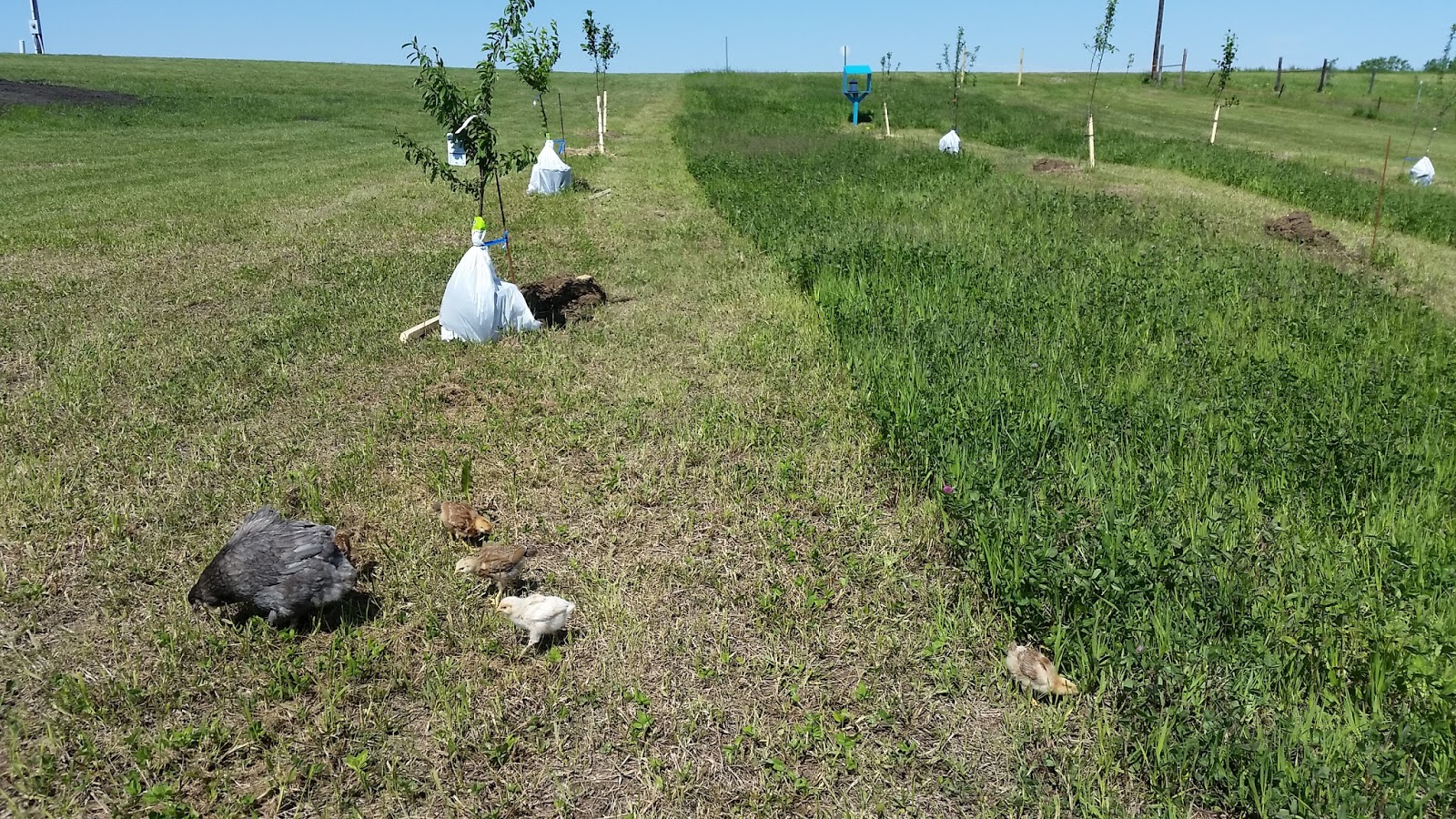
There you have it.  The orchard at the Station is in.  It is doing well.  The trees are leggy this year and suffering a little from cedar rust disease, but next spring before they come out of hibernation, I'll prune them properly and spray them.  It will take me a few years to really get to enjoy it at its fullest, but I promise not to wear a white pantsuit and heels to harvest!